
 Elcam Bioprocess
 Elcam Drug Delivery Devices
Stopcock Types OEM Guide
Medical stopcocks are among the most widely used fluid-control components in disposable medical systems. They start, stop, redirect, or isolate fluid pathways in IV therapy, anesthesia, critical care, dialysis, pressure monitoring, and other clinical workflows.

The main types are standard stopcocks in 1-way, 2-way, 3-way, and 4-way configurations, manifolds, high-flow stopcocks, high-pressure stopcocks, and specialty designs such as swabbable or closed stopcocks. Each type answers a different clinical and engineering need: port count and handle rotation determine which flow paths are available, material selection determines chemical and sterilization compatibility, and the pressure and flow profile determines where the component can safely be used. For OEM teams, choosing the right stopcock type affects not only flow control but also pressure performance, connection security, infection control, manufacturability, and integration into the final device. The sections below cover each type, the materials used, the pressure and flow categories, the specialty designs, and the customization options an OEM buyer should evaluate before specifying a part.
What Is a Medical Stopcock?
A medical stopcock is a manually operated valve used in disposable medical tubing systems to control, redirect, or stop the flow of fluids, medications, or pressure between connected lines. Most stopcocks include a rotating handle and two or more ports. By turning the handle, the user can open flow between selected ports while blocking others.
In practical terms, a stopcock medical device helps clinicians manage fluid pathways safely and efficiently without disconnecting lines. That makes stopcocks essential in procedures where multiple infusions, pressure lines, syringes, or sampling points must be managed from a compact connection point.
For OEM manufacturers, stopcocks are not standalone accessories. They are integrated components used inside infusion sets, pressure-monitoring kits, anesthesia circuits, manifolds, and other disposable medical assemblies. Elcam’s main Stopcocks page provides an overview of the broader portfolio and related configurations.
What Are the Main Types of Medical Stopcocks?
The most common stopcock types used in medical procedures can be grouped by port configuration, pressure capability, and functional design.
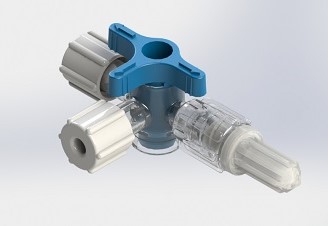
3-Way Stopcocks
The 3-way stopcock is the most common format in medical practice. It includes three ports and allows flow to be directed between any two ports while the third is closed. This design is widely used in IV therapy, pressure monitoring, anesthesia, and general fluid management.
A 3-way stopcock is often the default choice when a clinician or device needs one inlet, one outlet, and one additional access point for medication delivery, sampling, flushing, or pressure measurement.
Different types of 3-way stopcock used in medical procedures include standard stopcocks for routine infusion and fluid control, high-flow stopcocks for lower resistance and faster delivery, high-pressure stopcocks for demanding pressure environments, and stopcocks with tube for added flexibility and reach. They are useful in applications where multiple inputs or access points must be managed together, especially in advanced monitoring or multi-line administration environments.
Manifolds
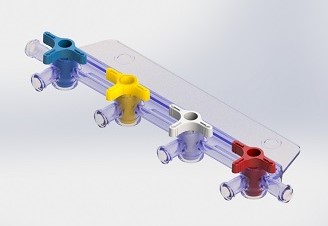
A manifold combines multiple stopcocks into one connected unit. Instead of using separate individual stopcocks, the clinician or device works from one central fluid-management assembly.
Manifolds are commonly used in ICU, anesthesia, operating-room, and neonatal-care environments where several medications or fluid lines must be managed simultaneously. They help centralize access, reduce line complexity, and support more organized workflows.
For related manifold solutions, see Elcam’s Standard Manifolds and Closed & Marvelous Manifolds.
3-Way vs. 4-Way Stopcock: What Is the Difference?
Most people use “3-way stopcock” as a generic name for any stopcock with three ports. The official terminology, however, refers to the number of flow directions rather than the number of ports.
3-way stopcocks are stopcocks with three ports and a single-arm handle with 180° rotation. They do not allow an all-open position.
4-way stopcocks are stopcocks with three ports and either a single-arm or a three-arm handle with 360° rotation, allowing all flow possibilities.
From an OEM perspective, the right choice depends on the number of lines that must be managed, the expected pressure and flow conditions, ease of use in the clinical setting, and the required connection strategy.
Materials Used in Medical Stopcocks: PC, PSU, and Tritan
Material selection is one of the most important engineering decisions in stopcock design. The most common materials used in medical stopcocks are polycarbonate (PC), polysulfone (PSU), and Tritan™, though other medical-grade plastics may also be used depending on the application.
Polycarbonate (PC)
Polycarbonate is often selected when transparency and higher mechanical performance are important. In stopcock design, transparency can help with visual inspection, including fluid visibility and air-bubble detection. PC is also associated with stronger pressure performance in many designs. PC is available in a variety of grades to fit different needs and applications, including grades selected for EtO or gamma sterilization compatibility and grades selected for solvent-bonding durability.
Polysulfone (PSU)
This body material provides superiority in resistance to lipid solutions as well as leading chemotherapeutic agents. It is also EtO and gamma sterilization compatible.
Tritan™
Tritan™ is a body material with increased durability to lipids, disinfectants, and aggressive drugs, compatible with both gamma and EtO sterilization. Tritan™ is also BPA free.
Why Material Choice Matters
The choice between PC, PSU, and Tritan™ affects pressure tolerance, chemical compatibility, visual clarity, sterilization compatibility, durability during use, and validation requirements. For OEM medical devices, material selection should always match the intended fluid, pressure conditions, sterilization method, and clinical use case.
Pressure Ratings: Standard vs. High-Pressure vs. High-Flow
Not all stopcocks are designed for the same pressure or flow demands.
Standard Stopcocks
Standard stopcocks are used for general fluid-control applications such as routine infusion and low-to-medium pressure delivery.
High-Flow Stopcocks
High-flow stopcocks are designed with lower resistance and an enlarged flow path to support faster fluid transfer. They are useful when rapid delivery or lower flow restriction is important.
High-Pressure Stopcocks
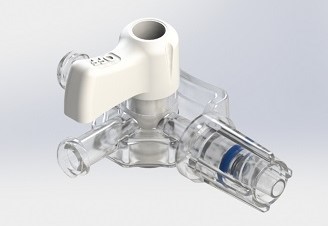
High-pressure stopcocks are designed for applications where the system operates under more demanding pressure conditions. These may include different interventional environments, and other applications where pressure resistance is critical to performance and safety.
High-flow does not necessarily mean high-pressure. These are different performance attributes. A stopcock can be optimized for higher flow, higher pressure, or both, depending on the design.
Specialty Stopcock Types
Beyond standard port and pressure categories, there are specialty stopcock medical device designs created for more specific clinical or OEM needs.
Closed Swabbable Stopcocks
A swabbable stopcock includes a needle-free Luer-activated valve designed for disinfection.
Closed stopcocks are designed to reduce exposure of the fluid path to the external environment. They can support safer fluid handling and improved infection-control workflows compared with more open access designs. They also eliminate Needle stick injury.
Minimal Residual Volume Luer-Activated Stopcocks
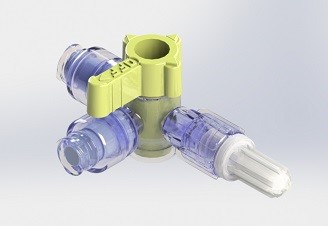
These unique and innovative stopcocks comprise a needle-free Luer-activated valve that helps prevent bacterial and air ingress, together with a proprietary inner channel that is continuously flushed by the carrier fluid, reducing the risk of contamination, clotting, and drug residue buildup.
In OEM development, these integrated solutions can help reduce component count, simplify workflows, and support differentiated clinical use. Related solutions can be explored through Elcam’s Closed & Marvelous Stopcocks.
Medical and Surgical Applications of Stopcocks
Stopcocks are used across many medical care environments because fluid routing is fundamental to modern disposable systems.
ICU and Critical Care
In intensive care, stopcocks are used in infusion systems, multi-drug administration setups, pressure lines, and blood sampling applications. Manifolds are especially relevant where multiple medications must be managed from one access point.
Anesthesia
In anesthesia circuits and perioperative care, stopcocks help manage fluid delivery, line access, pressure sensing, and controlled routing of connected components.
Infusion Pumps and IV Therapy
In IV therapy and infusion systems, stopcocks provide line access, medication switching, flushing options, and controlled delivery through a compact valve mechanism. In many setups, stopcocks with extension tube provide added flexibility and workflow convenience.
Pressure Monitoring
Pressure-monitoring systems often require stopcocks that can maintain secure, leak-resistant performance while enabling continuous pressure sensing and blood sampling.
Interventional Cardiology & Radiology
Interventional Cardiology & Radiology (IC&R) procedures call for flow control devices built for demanding conditions. as they need to withstand high pressure conditions. IC&R stopcocks and manifolds also remain in the physician’s hand throughout the entire procedure, ready for instant use at any moment. That’s what makes ergonomic design a critical requirement for these special stopcocks.
OEM Customization: What Buyers Should Evaluate
For OEMs, selecting a stopcock is rarely about choosing a generic catalog item alone. The real requirement is selecting or developing a component that fits the final medical device, workflow, and validation plan.
Customization normally starts with the port configuration — 1-way, 2-way, 3-way, 4-way, or a full manifold — and the connection type, whether Luer lock or Luer slip. From there, OEM teams specify the pressure profile and whether the flow path should be optimized for high flow, along with tubing integration and port orientation. Handle options include single-arm or three-arm designs, together with handle color and color coding for line identification. Material selection follows from the intended fluid, pressure conditions, and sterilization method, and the access design can be specified as open or closed swabbable with or without an inner channel . Packaging and labeling requirements complete the specification.
A strong OEM stopcock partner should be able to support both standard product selection and custom design-to-spec development when the application requires it. Elcam’s broader Stopcocks portfolio is a useful starting point for evaluating available configurations and related subcategories. For application-specific requirements, Elcam’s engineering team can be reached through the contact page.
Conclusion
A medical stopcock may look like a small component, but it plays a major role in the performance, usability, and safety of disposable medical systems. The right choice depends on more than port count. OEM teams need to evaluate flow, pressure, materials, access design, infection-control requirements, and final device integration.
In simple terms, 3-way and 4-way stopcocks suit broad clinical routing needs as well as more complex multi-line setups, a manifold supports centralized fluid management, and high-flow or high-pressure designs should be selected based on actual system demands. Material choice, specialty access design, and OEM customization all play a role in matching the stopcock to the final medical application.
That is what turns a stopcock from a commodity part into a true OEM design decision.
FAQ
What is a medical stopcock?
A medical stopcock is a manually operated valve used in IV therapy, anesthesia, and critical care to control, redirect, or stop the flow of fluids and medications through a line. It typically includes a rotating handle and two or more ports.
What are the different types of 3-way stopcocks used in medical procedures?
The main types include standard stopcocks, high-flow stopcocks, high-pressure stopcocks, stopcocks with extension tube, and swabbable or specialty configurations used in specific clinical workflows.
What is the difference between a 3-way and a 4-way stopcock?
3-way stopcocks are stopcocks with three ports and a single-arm handle with 180° rotation, which does not allow an all-open position. 4-way stopcocks are stopcocks with three ports and either a single-arm or a three-arm handle with 360° rotation, allowing all flow possibilities.
What is a manifold?
A manifold is a multi-port assembly that combines two or more stopcocks into one connected unit, allowing several lines or infusions to be controlled from one central point.
What materials are commonly used in medical stopcocks?
Medical stopcocks are commonly made from polycarbonate (PC), polysulfone (PSU), and Tritan™, depending on the needed balance of chemical resistance, transparency, sterilization compatibility, and pressure performance.
What is the difference between standard, high-flow, and high-pressure stopcocks?
Standard stopcocks are used for general fluid control, high-flow stopcocks are optimized for faster delivery and lower resistance, and high-pressure stopcocks are designed for more demanding pressure environments.
Where are medical stopcocks used?
They are commonly used in ICU, anesthesia, IV therapy, infusion systems, pressure-monitoring and interventional cardiology & radiology applications.
Can medical stopcocks be customized for OEM applications?
Yes. OEM customization can include port configuration, material choice, tubing integration, connection type, pressure profile, handle design, and packaging requirements.
View several examples of Elcam’s customized products
