Elcam Bioprocess
 Elcam Drug Delivery Devices
Y-Click™: New Approach to Hemostatic Valve Technology for PTCA Procedures
Tomer Gil
A hemostatic valve for PTCA procedures should help clinicians maintain control, reduce blood loss, prevent air ingress, and support fast device manipulation during interventional cardiology procedures. Y-Click™ is Elcam’s Y connector hemostatic valve for PTCA and interventional procedures, designed with one-handed operation, audible position feedback, and a three-stage valve mechanism.
By combining ergonomic control with clear valve-position feedback, Y-Click™ helps interventional teams manage guidewires, catheters, and contrast injection workflows while maintaining a sealed procedural environment.
Hemostatic Valves in Interventional Cardiology
Hemostatic valves are crucial components in medical devices used for catheter-based procedures. These valves serve a vital function by preventing bleeding during interventions and maintaining a clean surgical field, while allowing medical instruments to pass through and maintain a sealed environment. In minimally invasive procedures, particularly Percutaneous Transluminal Coronary Angioplasty (PTCA), hemostatic valves are essential for ensuring procedural success and patient safety.
What Is a Hemostatic Valve Used for in PTCA?
A hemostatic valve is used during catheter-based procedures to help maintain a sealed pathway while allowing interventional devices to pass through. In PTCA procedures, clinicians may need to introduce, manipulate, and withdraw guidewires, balloon catheters, and other devices while minimizing blood loss and maintaining procedural control.
In this setting, the valve must balance two needs that can compete with each other: allowing smooth device movement while maintaining an effective seal. If the valve is too tight, device manipulation may become more difficult. If the valve is too loose, blood loss or leakage may increase.
Y-Click™ was designed to support this balance with a three-stage valve system that gives clinicians more control over the level of opening, sealing, and device mobility during the procedure.
The Critical Role of Hemostatic Valves in PTCA
PTCA is a minimally invasive procedure designed to open blocked coronary blood vessels and improve blood flow to the heart muscle. During this procedure, physicians insert a catheter, guiding it to the coronary arteries. After injecting dye for X-ray visualization, they use a balloon catheter to compress blockages against the artery wall, often placing a stent to keep the artery open.
Throughout this complex process, hemostatic valves play an indispensable role by preventing blood loss during instrument manipulation, maintaining a sealed environment for the procedure, enabling smooth introduction and withdrawal of various devices, and contributing to overall procedural efficiency and patient outcomes.
Y-Click Hemostatic Valve Design
Elcam Medical’s Y-Click represents a significant advancement in hemostatic valve technology for PTCA applications. Developed in close collaboration with interventional experts, this easy-to-use hemostatic device is suitable for both diagnostic and interventional procedures in cardiology.
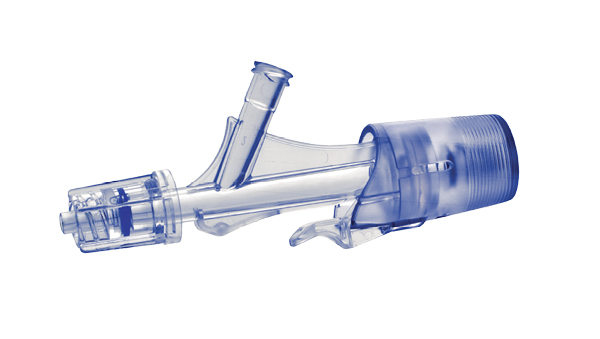
How Y-Click Transforms the PTCA Experience
The ergonomically designed Y-Click provides easy maneuvering and may help to reduce blood loss during the introduction, use, and withdrawal of diagnostic and interventional devices used in angioplasty procedures.
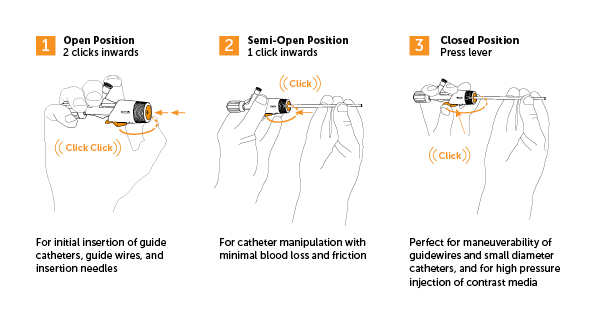
What sets it apart is its unique three-stage lever-operable valve with distinct positions:
3 Key Differentiators That Benefit Cardiologist
- One-Handed Operation for Enhanced Procedural Control
Y-Click’s design enables one-handed operation, freeing the cardiologist’s other hand for additional tasks or instrument manipulation. This single-hand functionality represents a significant advantage in the busy interventional setting, allowing for more efficient procedural workflow and potentially reducing overall procedure time. - Intuitive Audible Click System
One of Y-Click’s standout features is its audible “clicks” that clearly indicate position changes. The “click” provides immediate feedback to the surgeon without requiring visual confirmation, enhancing confidence and precision during critical moments of the procedure. - Blood Loss Prevention
Y-Click effectively prevents back bleeding in the Closed position and minimizes back bleeding in the Semi-Open position, which balances instrument maneuverability with minimal bleeding. Exclusive to Y-Click, this middle position allows for catheter manipulation with reduced friction while still maintaining an effective seal. Additionally, Y-Click offers a high inner diameter that accommodates a wider range of instruments while maintaining excellent sealing properties.
Advanced Safety Features
Beyond its primary benefits, Y-Click incorporates several advanced safety mechanisms. It prevents air ingress into the device when the valve is in Semi-Open and Closed positions. The self-closing safety mechanism automatically moves from Semi-Open to Closed position when high pressure is applied during contrast media injection, and it provides good signal keeping in both Closed and Semi-Open positions.
Technical Performance That Meets Demanding Needs
The Y-Click is engineered to perform in demanding interventional environments:
- Compatible with automatic contrast media injectors (up to 15cc per second and 600 psi)
- Suitable for use with 9 Fr or smaller guide catheters
- Works with 0.014″ – 0.038″ diameter guide wires
- Meets strict biocompatibility requirements (ISO 10993-1)
- FDA 510(k) cleared (K060759)
Y-Click’s Impact on PTCA Procedures
The Y-Click hemostatic valve represents a significant advancement in PTCA technology. By focusing on surgeon-centric design with one-handed operation, audible position confirmation, and superior blood loss prevention, Y-Click enhances procedural efficiency while potentially improving patient outcomes.
For interventional cardiologists seeking to optimize their PTCA procedures, Y-Click offers a combination of intuitive operation, enhanced control, and advanced safety features not found in conventional hemostatic valves.
You may also be interested in:
https://www.elcam-medical.com/wp-content/uploads/2024/03/Y-Click_REV7A_03-2024_v1.pdf
FAQs
What is a hemostatic valve used for in PTCA?
A hemostatic valve is used in PTCA and catheter-based procedures to maintain a sealed environment while allowing guidewires, catheters, and interventional devices to pass through. Its role is to help reduce blood loss, prevent air ingress, and support controlled device manipulation during the procedure.
How does Y-Click™ differ from a conventional hemostatic valve?
Y-Click™ differs from a conventional hemostatic valve through its one-handed operation, audible position feedback, and three-stage valve mechanism. It includes closed, semi-open, and open positions, allowing clinicians to balance device movement with blood-loss management during PTCA procedures.
What features matter most in interventional cardiology valve selection?
Important features include blood-loss management, smooth guidewire and catheter movement, one-handed usability, clear valve-position feedback, air ingress prevention, pressure-related safety behavior, and compatibility with the devices used in PTCA or interventional cardiology workflows.
What is the benefit of a one-handed hemostatic valve?
A one-handed hemostatic valve allows the clinician to adjust valve position while keeping the other hand available for device manipulation. This can support better procedural control and workflow efficiency during catheter-based interventions.
What is the advantage of audible valve-position feedback?
Audible valve-position feedback helps the operator recognize position changes without relying only on visual confirmation. In a busy interventional setting, this can support confidence, speed, and control during critical procedural steps.